
How to Create an Indian Grazing Table
A practical guide to laying out a grazing-style spread for an Indian gathering — anchors, small bowls, height, and what to leave empty.
The Table Story · · 4 min read
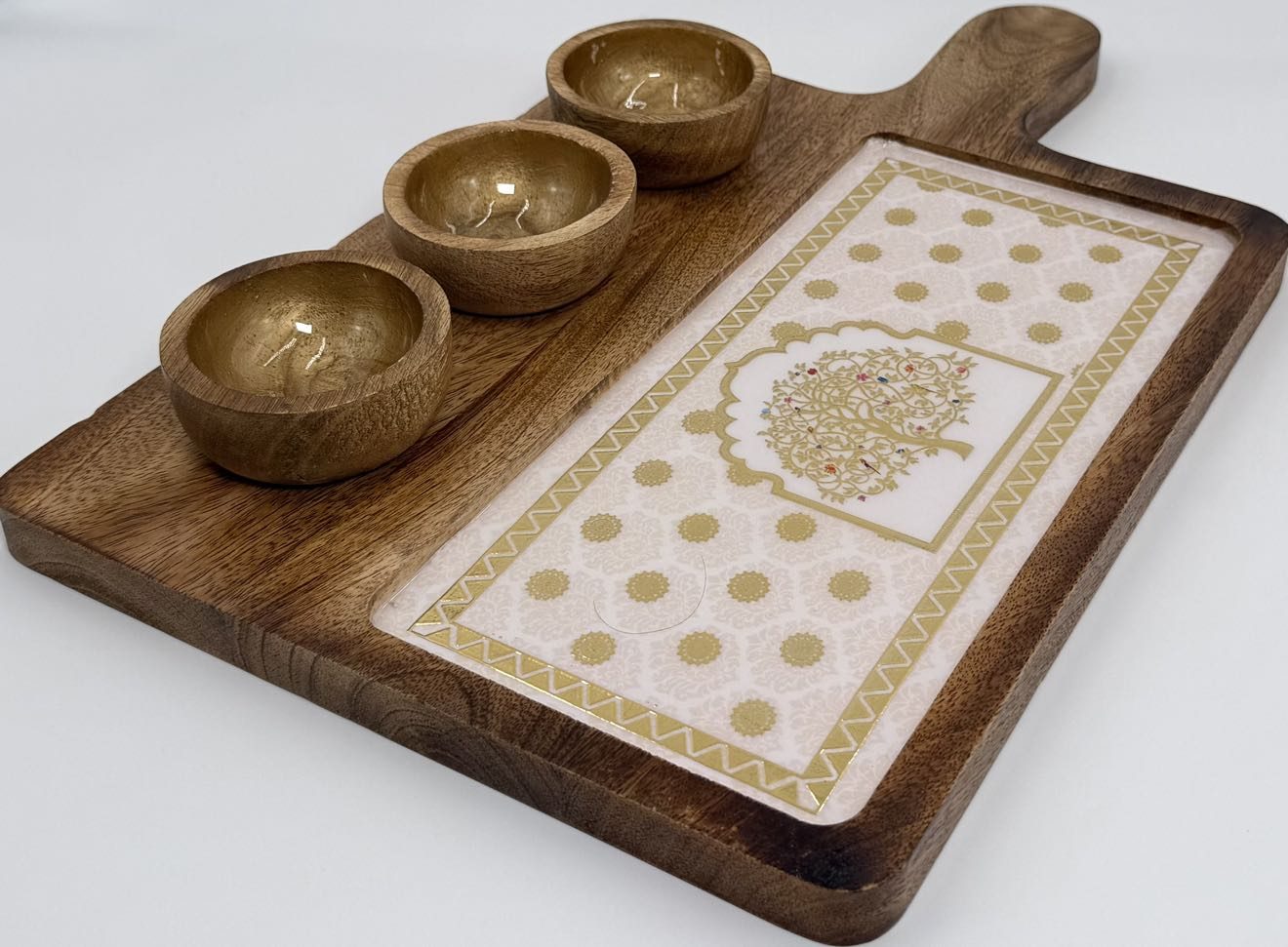
A grazing table sounds like a borrowed idea until you look at how Indian families already eat when people come over. Snacks stay out for hours, someone keeps refilling the chivda, and nobody sits down until the last minute. A grazing table simply gives that habit a shape.
It also solves the two real problems of hosting at home: the kitchen is busy exactly when guests arrive, and Indian food is rarely one course at a time. Laid out well, a spread lets sweet, savoury, spicy and fresh sit beside each other without competing, and lets guests serve themselves while you finish what's on the stove.
Here is how to build one that holds together.
1. Start With the Right Base
Any flat surface works — a dining table pushed against the wall, a console, even a sturdy centre table. What matters is circulation. If guests have to reach across each other, the table stops being relaxed within ten minutes.
If the table sits in the middle of the room, keep roughly three feet clear on all sides. If it's against a wall, plan for people to approach from one long side and keep everything within an arm's reach of that edge — nothing important at the back.
Lay a runner or a plain cloth first. It gives the arrangement an edge to work against, and it makes the pieces on top read as one composition rather than a collection of separate dishes.
2. Put the Largest Serving Pieces Down First
Work big to small, always. Place your two or three largest platters first and treat them as anchors — one near the centre, the others set diagonally away from it. Everything smaller then fills the gaps between them.
Do this before any food comes out. Arranging empty pieces takes two minutes and tells you immediately whether the table is over-planned.
3. Add Small Bowls for Dips, Chutneys & Accompaniments
Chutneys, raita, achaar and anything with moisture belong in their own bowls — not spooned onto a platter where they run into the dry snacks. Beyond the practical reason, small bowls break up large surfaces and give the eye somewhere to stop.
Two habits worth keeping: place each bowl next to what it goes with rather than in a row of its own, and give every dip its own spoon. A shared spoon slows a table down more than anything else.
4. Create Different Heights
A flat table photographs badly and, more importantly, serves badly. Everything at one level means everything competes for attention and the pieces at the back get ignored.
You only need one or two raised points. Put mithai or bite-sized desserts on a stand, stack a pair of trays under a platter to lift it, and leave the rest low. Height also buys you surface area, which matters when the guest list has grown and the table hasn't.
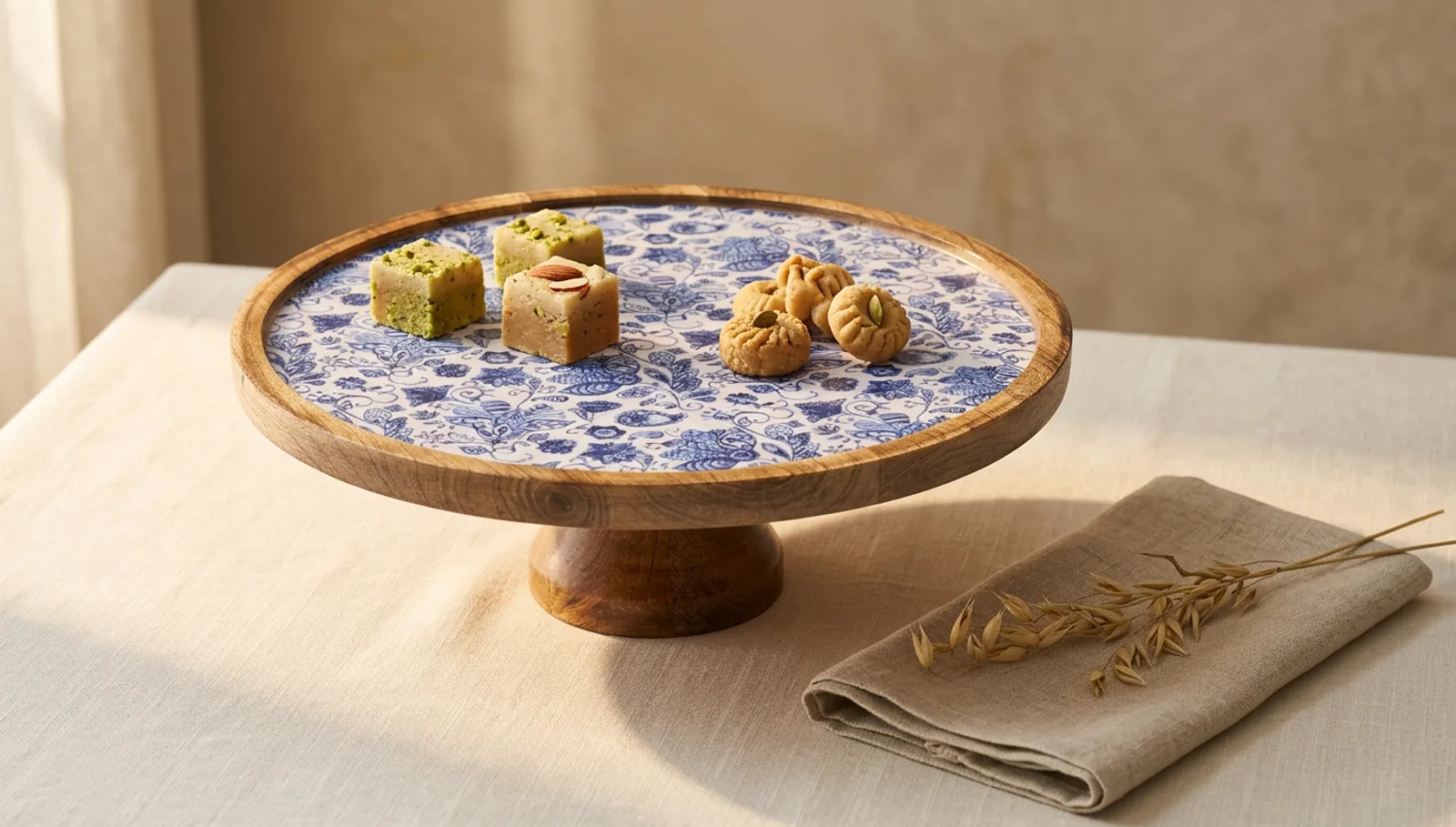
5. Mix Familiar Indian Favourites With Easy-to-Pick Foods
The food should need nothing more than a hand or a small spoon. Anything that requires cutting, balancing or a full plate belongs at dinner, not on the grazing table.
A useful working mix — adapt it to what your family actually eats:
- Namkeen and savouries: chivda, sev, mathri, khakhra, masala peanuts.
- Nuts and dry fruit: roasted almonds, cashews, walnuts, dates, apricots.
- Fruit that holds: grapes, sliced apple, pomegranate, chikoo, seasonal melon.
- Something warm in small portions: kebabs, mini tikkis, paneer bites, samosas cut in half.
- Dips and chutneys: pudina, imli, hung curd, hummus if your crowd likes it.
- Breads and crackers: khakhra, lavash, papad, crisp bread for the dips.
- Mini sweets: kaju katli, laddoo, barfi cut small, chocolate for the children.
Two things keep a mixed spread coherent. Group by texture rather than by course — crisp together, soft together, fresh together — and repeat a design across several pieces so the table reads as a set even when the food doesn't match.
6. Leave Some Negative Space
The instinct is to keep filling until no wood shows. Resist it. Empty space is what lets a guest put down a glass, what stops the table looking like a buffet counter, and what makes the good pieces look deliberate.
A rough test before guests arrive: could someone set a plate down anywhere along the front edge without moving something first? If not, take one dish off. The table almost always improves.
If you want a worked example of the same restraint on a smaller, seated table, this pairs well with our earlier piece:
5 Ways to Style Your Festive Table
7. Finish With Something Guests Discover Later
The best hosting has one small thing that arrives after everyone assumes the evening is done. Usually it's mukhwas.
Our Masala Box is made as a compartmented spice box, but a lot of hosts use it the other way round — saunf in one section, mishri in another, dhaniya dal, supari, whatever your house finishes a meal with. Keep it closed on the side of the table through the evening and open it at the end. It brings people back for one more round of conversation, which is usually the part they remember.
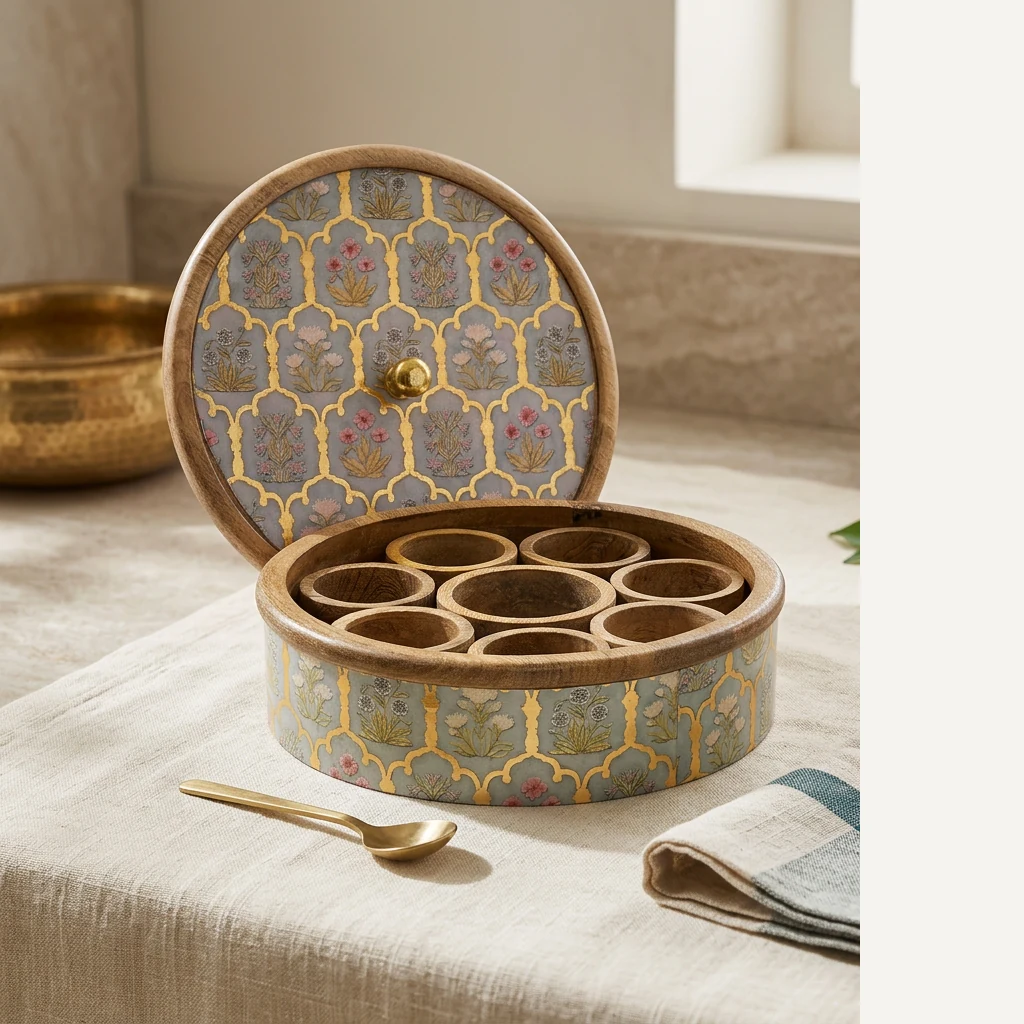
If you would rather not assemble the pieces one by one, our curated sets group platters, bowls and trays that already work together.
And if you prefer to judge scale and weight in person before a big evening, the whole range is on the shelves at our Crawford Market store.